Books are a perfect example of what I’ll call static media. They’re just words on a page, requiring active participation from the reader in order to use. On the opposite end of the spectrum is TikTok, which plays infinite short-form videos for you, with almost no participation required from the viewer but the flick of their thumb. I’d call TikTok active media, in that the media is literally playing an active role in its own use: it is playing a video for you and tacitly prompting you to scroll to the next one.
Static and active media encourage the opposite characteristics in their user.
Between an observer and the media they’re paying attention to, whichever is more active is the subject, and whichever is less active is the object. If your mind has become totally static though TikTok use, you’re the object, not the subject. TikTok is in control. If your mind has become more active through the requirements of long form reading, you’re the subject. The book is serving you.
The reasons for this are simple enough: you cannot engage with static media without conscious effort to control your mind. To read a book you have to actively read the words, resist distractions so that a mental picture can form from those words, and if you’re bored with what you’re reading, you must actively re-commit in order to continue. Books don’t read themselves. With active media, rather than you prompting your mind to continue, your mind is prompted to continue by the media itself, and you respond.
The important part is that this is not binary. It’s not either/or. Instead, you are pushed and pulled in different directions by different forms of media. The phrasing above was chosen intentionally: In the relationship between a person and the media they’re attending to, whichever is more active is the subject, and whichever is less active the object. It is possible to use TikTok occasionally and still remain the more active participant in that relationship. The same goes for twitter, sitcoms, and movies. Being the active participant is a mental state and not inherent in the type of media you’re attending to. But, those types of media do push you in their own direction. Active media pushes the mind to be static in the same way that reading a book requires the mind to participate actively.
To use an analogy, these different forms of media have their own gravity. When using TikTok, where the only mental state required in order for you to continue watching it is the impulse to flick your thumb and to see another video, your mind isn’t required to do very much. And a mind will generally only do what it needs to. It may be trained from other life habits to be stronger and more active. But given enough time with nothing but TikTok as an influence, your mind is going to soften and relax, simply because nothing else is needed from it. It’s like what gravity does when you drop a ball on the ground: if no one is there to catch it, it will fall to the ground, bounce for a little bit, then lie still until acted on by something else.
By contrast, this analogy paints a pretty clear picture of how reading tends to have the opposite effect on someone’s mind: there is no such thing has reading without being active. Picking up the ball and tossing it around is inherent to long form reading because it is required by long form reading. You don’t just need to respond to the impulse to flick your thumb. You have to actively move through the words on the page, clear your mind of distractions so that the scenes and ideas can stick in your memory, and sometimes muster up the energy to keep going.
If gravity is analogous to the force that the media and person exert on each other, and if the “activity” of each is analogous to the size of the body (the more active, the larger the body), then the relationship between a person and media is like gravity between two objects in space: the larger object will pull the smaller one into its orbit. The more active participant will pull the less active one into its orbit.
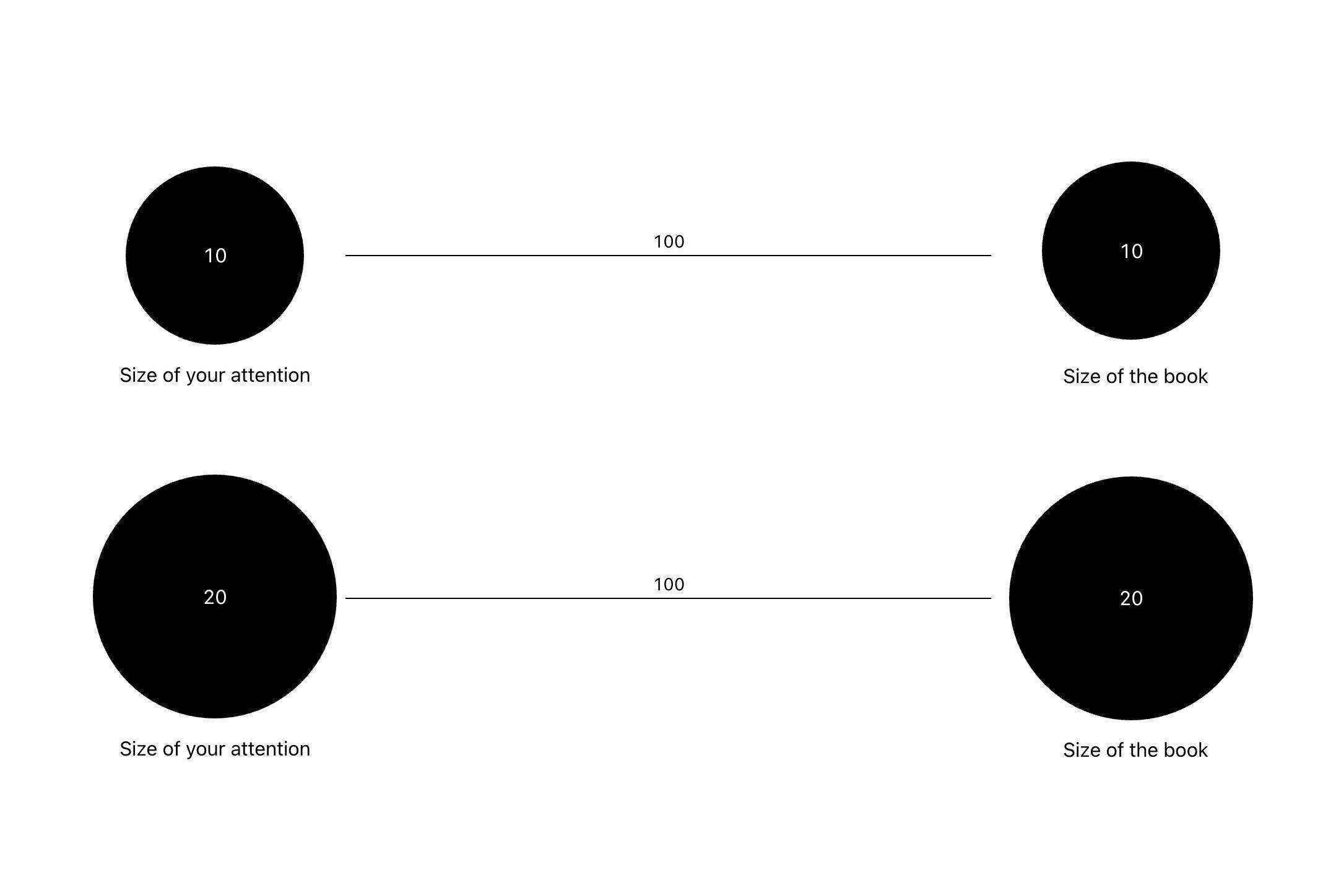
Thinking of it this way, it all becomes pretty simple: Because it’s impossible to read without active participation, it’s impossible to be “pulled into a book’s orbit.” You and the book revolve around each other. Your attention has to grow in order to even read it. And, as it happens, a book can only give you as much as your attention allows. It can never outstrip the reader in size.
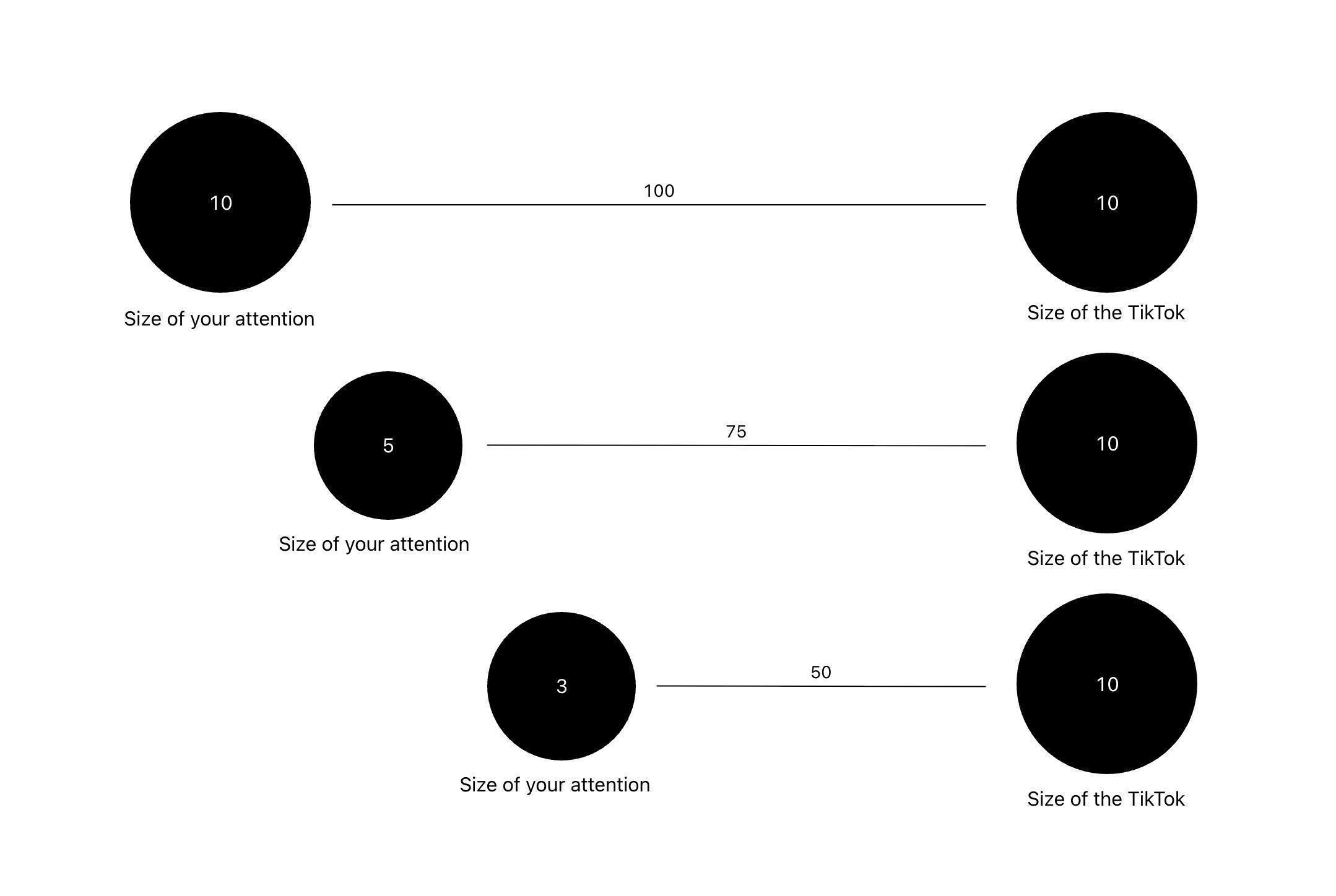
Tiktok, Twitter, Instagram, and even sitcoms and movies are not the same way. It is not necessary that they cause the viewer to become smaller than them. But, unlike books, it is also not necessary that you remain the same size as that media in order to even observe it. It is now possible for your attention to shrink in proportion to that media. To an extent, those forms of media might even encourage it. And—Murphy’s Law—now that you have somewhere to fall, you probably will fall.
One of the takeaways for me from all this is that Twitter, TikTok, and TV can be used safely as long as they are complements to your media diet. Your anchor needs to be in long form reading and writing. If that anchor slips away, it could get bad. This is encouraging because we’re getting to a point where it’s hard to participate in life, culture, or markets without these social media style sources of information. OSINT accounts on Twitter put out information on wartime activities fully hours before a wire service like AP does. Twitter allows you to witness how the market is responding emotionally to important news in real time. TikTok is where new memes and attitudes are formed and quickly bleed into real life.
We’re increasingly getting to the point that you are genuinely missing out if you are not using these active medias like Twitter. You can’t just retreat to the WSJ or an RSS feed and get the same results. But, understanding the above, you can safely use those sources of information without being pulled into their orbit and losing your control over your own mind.